Most epic Blue Ridge Mountain road trips revolve around overlooks, waterfalls, and hiking trails.
But some of the most peaceful hours in these mountains happen at water level– mist lifting off a lake at sunrise, a quiet cove, and nothing on the schedule except a slow paddle before breakfast.
Kayaking in the Blue Ridge Mountains takes some research, especially if you want to camp by the water.
Most Blue Ridge Parkway lakes are closed to boats, several lakes nearby ban gas motors, and popular campgrounds take reservations up to six months ahead.
Here are four lakes and a river in North Carolina and Virginia where you can paddle and camp, plus tips on seasons, rules, packing, and Leave No Trace guidelines to follow.
READ MORE: The 10 Best Kayaking Rivers in Georgia
5 Calm-Water Kayaking Spots With Camping Nearby
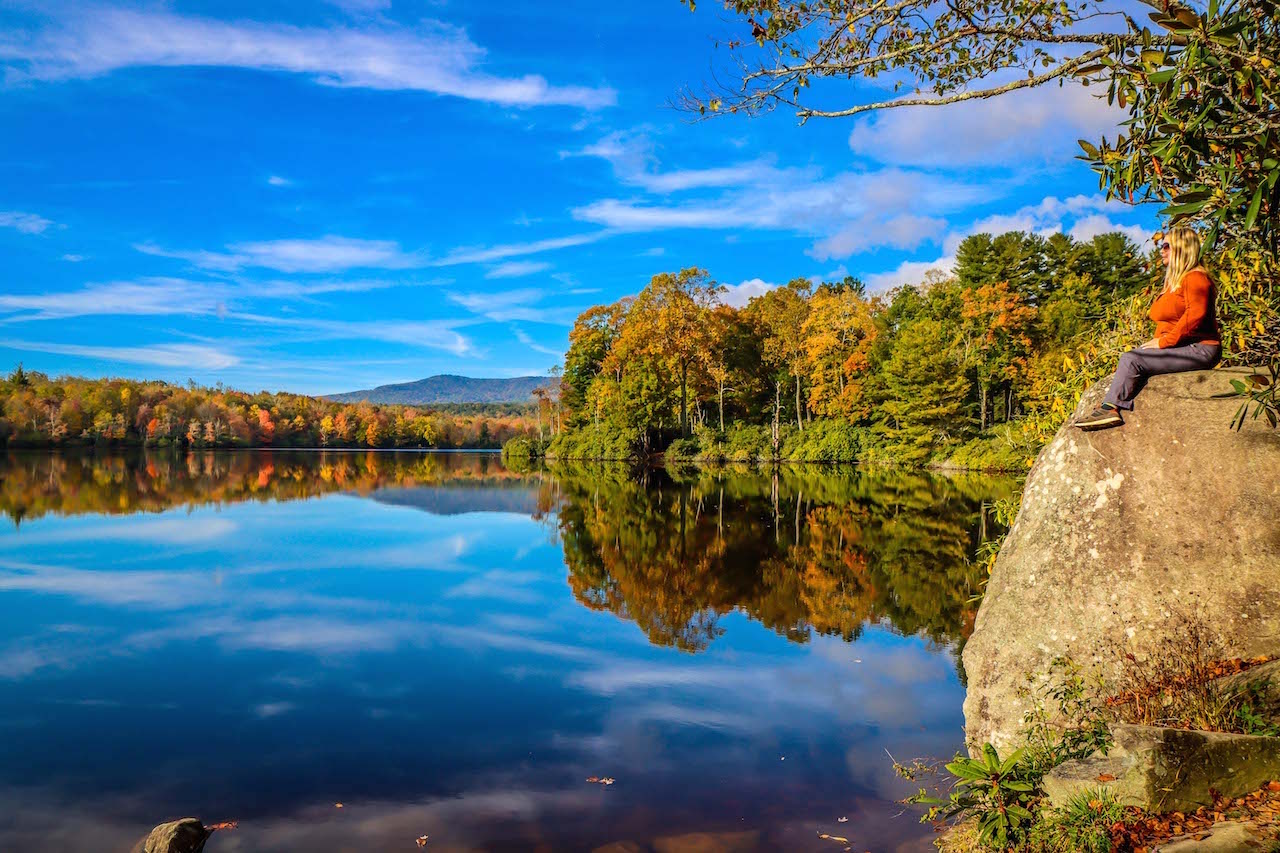
1. Price Lake, Blue Ridge Parkway (NC)
Julian Price Memorial Park stretches from Milepost 295.8 to 298.6, just south of Blowing Rock. Its focal point is the 47-acre Price Lake, which is set in a park that ranges from 3,000 to 4,000 feet in elevation.
PADDLING: Non-motorized boats only, and you may launch only from the two ramps at the boat rental concession, which rents canoes, kayaks, and paddleboards in season. Life jackets must be worn on the water here, and swimming isn’t allowed in any Blue Ridge Parkway waters.
CAMPING: Julian Price Campground sits beside the lake, and is one of only two Parkway campgrounds with showers. Sites were $30 per night in 2026 and can be reserved up to six months ahead on Recreation.gov.
GOOD TO KNOW: Boats are prohibited on many other Parkway lakes, including Bass Lake, Trout Lake, and Abbott Lake.
READ MORE: Exploring Julian Price Campground & Memorial Park in Blowing Rock NC

2. Lake James State Park (NC)
Located about 50 miles northeast of Asheville, Lake James State Park has something every paddler should try once: campsites you can only reach by boat.
The Long Arm Peninsula has 30 paddle-in campsites, located anywhere from 20 to 150 feet from the shoreline, each with a fire pit, picnic table, and tent pad.
PADDLING: Motorboats use this big lake, too, so cross on calm mornings and stay near shore. Bringing your own boat? Get an overnight parking pass at the park office and leave your car at the Paddy’s Creek Access.
CAMPING: Reserve paddle-in sites before you arrive, and pack in all of your water. There’s none at the paddle-in sites, though toilets are provided. Paddy’s Creek also has 33 drive-in sites, with a bathhouse that’s open 24/7.
GOOD TO KNOW: Plan to bring your own boat. The park’s status page listed boat rentals as unavailable when this guide was written, so call ahead if you hope to rent.
READ MORE: The 20 Best Lakes in North Carolina (Mountains, Coast & Beyond)

3. New River State Park (NC)
Located about 35 miles northeast of Boone, New River State Park has seven accesses along a National Wild and Scenic River that the park describes as “shallow and gentle.”
Every access allows kayak launching, and some campsites can be reached only by paddling.
PADDLING: The river flows north toward Virginia, and the park map marks minor rapids and hazards in places, so study it before you launch.
CAMPING: For an easy first overnight, the park map lists Wagoner Access to the Riverbend paddle-in campsites at 1.5 miles, which is about an hour of moderate paddling. Register your vehicle for overnight parking, and check the park’s facility status before booking, as some river campsites have been closed for Hurricane Helene repairs.
GOOD TO KNOW: Paddle-in sites have no vehicle access, and you’ll finish downstream of your car, so plan a shuttle. The park lists a rental concessionaire nearby.
READ MORE: Kayaking in North Carolina: The 10 Best Rivers to Paddle

4. Sherando Lake Recreation Area (VA)
Just 3 miles off the Blue Ridge Parkway via State Route 664, the Sherando Lake Recreation Area in the George Washington and Jefferson National Forests is a classic paddle-and-camp combination.
Its campground sits between a small upper lake and the 25-acre, spring-fed lower lake at an elevation of around 1,800 ft.
PADDLING: No gas motors. Canoes, kayaks, and boats with electric trolling motors use the hand-carry ramp by the parking area, and can paddle anywhere outside the swimming area.
CAMPING: This campground is open from early April through late October. Reservations are required, and a single site was $25 per night in 2026.
GOOD TO KNOW: Because of Black Bear activity, all food must be stored in a food storage locker or a locked vehicle.
READ MORE: The 15 Best Lakes in the Virginia Mountains to Visit

5. Hungry Mother State Park (VA)
Developed by the Civilian Conservation Corps in the 1930s, Hungry Mother State Park (located near Marion VA) is known for its placid 108-acre lake.
PADDLING: The boat ramp is open to non-gasoline-powered boats, and the park rents canoes, kayaks, and paddleboards from Memorial Day weekend through Labor Day.
CAMPING: Camp Burson, located about a mile before the main entrance, is open all year-round.
GOOD TO KNOW: Outside the summer rental season, single and tandem kayaks can be rented through a self-serve app and kiosk in the park.
READ MORE: Hungry Mother State Park Cabins, Camping & Hiking Trails

Best Time to Kayak in the Blue Ridge Mountains
Early fall is often the sweet spot. It’s the driest season along the Parkway, with warm days, cool nights, and vivid Fall Colors reflected on the water. But note that higher elevations can see snow by November.
Elevation shapes everything here. The Parkway runs from just under 650 feet at Virginia’s James River to over 6,000 feet south of Mount Pisgah, and temperatures can differ by 10 to 20°F between the foothills and the crest.
Spring weather is unpredictable, and snow can still fall at higher elevations in March. Summer brings heat, humidity, and frequent afternoon thunderstorms, so paddle early.
Check individual campground calendars, too. Parkway campgrounds are open from May through late October, while Sherando is open from early April through late October, and Camp Burson is open year-round.
READ MORE: The 13 Best Blue Ridge Parkway Campgrounds to Visit

Paddling Rules, Permits & Safety
• Life jackets: Every paddler needs a Coast Guard-approved life jacket in the boat, and federal law says kids under 13 have to wear theirs while the boat is underway. Wearing one on every lake is the safer habit!
• Weather: Check the forecast before you launch, and head for shore if a thunderstorm starts to build.
• Fishing: Price Lake accepts a North Carolina or Virginia license, while Sherando requires a Virginia license plus National Forest and trout stamps.
• Firewood: Only certified, heat-treated firewood may be brought onto the Blue Ridge Parkway.
• Conditions: Hurricane Helene damage still keeps some Parkway sections, trails, and campgrounds in western North Carolina closed. Check the Parkway’s road status page and each park’s alerts the week you go.
READ MORE: Where are the Blue Ridge Mountains? A State-by-State Guide

Packing a Portable Kayak for a Car-Camping Trip
Hauling a hard-shell boat on a kayak camping trip means using a roof rack, straps, and usually requires a second pair of hands at the launch.
An inflatable kayak sidesteps most of that. It rides in the trunk of your car/SUV, and getting to a hand-carry ramp like Sherando’s means carrying a bag, not a heavy 12-foot hull.
If you’re shopping, packable inflatable touring kayaks are worth considering for exploring lakes like these.
A longer touring shape tracks straighter across open water than a short recreational boat, which helps on a big lake like Lake James or on the paddle out to a campsite.
• Test-inflate at home, and keep the pump, pressure gauge, and repair kit together.
• Pack a paddle, a fitted life jacket for everyone, and dry bags for sleeping bags and electronics.
• Load the kayak bag last so it comes out first at the launch.
• Dry the boat completely before you store it at home.
READ MORE: Why the 7 Principles of Leave No Trace Matter Now More Than Ever

Leave No Trace on the Water
The Blue Ridge Parkway promotes the 7 Leave No Trace principles, and they translate easily to a paddling trip:
• Know each park’s boating and camping rules before you go.
• Camp and land on durable surfaces such as established sites, ramps, gravel, or rock, not fragile shoreline vegetation.
• Pack out all trash and food scraps. Where there are no toilets, dig catholes 6 to 8 inches (15 to 20 cm) deep and 200 feet (60 meters) from water, camps, and trails.
• Leave rocks, plants, and artifacts where you find them.
• Keep fires small and use established fire rings.
• Watch wildlife from a distance, and never feed animals.
• Keep noise down on the water and respect campground quiet hours.
We recommend picking one lake for your first overnight paddling trip, reserve early, and let the rest of the trip slow down to paddling speed! –by Alex S. Morrison; lead image of Price Lake by Bret Love & Mary Gabbett